 Bloom: Illustrated Journal
How to keep a daily gratitude journal that survives the busy weeks

To keep a daily gratitude journal, write three short lines at a moment you already have each day, and decide now what a missed day means so one gap does not end it. The habit survives on small entries and a forgiving rule, not on long pages or perfect attendance.
In short
- Three lines a day is enough. Specific beats long.
- Attach it to something you already do: the kettle, the commute, the lamp going off.
- Daily is a habit choice, not a research instruction. Some studies used a weekly list.
- Write your missed-day rule before you need it.
- Paper or app both work. Pick the one you will still open on a tired Thursday.
A daily gratitude journal in three lines
If you are wondering how to start a gratitude journal, start smaller than feels serious. The unit is three lines, each about one thing, each specific enough that you could picture it next year.
- One thing that happened. Not “my family” but “my sister rang just to read me a bad joke.”
- One thing you noticed. Light on the kitchen wall, the first warm coat day, a quiet train.
- One thing that made the day easier. A person, a tool, a bus that was late in your favour.
Specific lines matter because the general ones go stale. Write “health” for a fortnight and the page stops asking anything of you. A small, dated moment keeps you looking. The Wikipedia summary of gratitude journal research says including three to ten items in each entry is reported to give the most benefit, so three sits at the gentle end of the range.
Blank days happen, which is what prompts are for. “What smelled good today?” or “Who made today a little easier?” will carry you through an evening when nothing comes. Treat a prompt as an offer, not homework.
A longer list is in 60 gratitude journal prompts.
Morning or evening: pick the one you will keep
There is no right hour. What matters is that the habit hangs on a moment you already have, because habits attach to cues rather than intentions.
Evening suits people who want to close the day. The day’s small moments are still fresh, and three lines before the lamp goes off is a natural stopping point.
Morning suits people whose evenings are unpredictable, such as parents of small children, shift workers, or anyone who falls asleep mid-sentence. You write about yesterday, which is fine. Yesterday counts.
Try one for two weeks. If you keep missing it, the slot is wrong, not you.
One honest note on “daily”. The best-known study, by Emmons and McCullough, had people keep a weekly list of five things, while other participants kept daily journals and also reported benefits. The same Wikipedia summary says researchers disagree about weekly versus daily: some argue weekly works better because people get used to daily entries quickly. So daily is a choice about habit, not a dose. Many people find a small daily habit easier to keep than a weekly one they keep forgetting. What the research found, limits included, is covered in what journaling actually does.
When you skip a day (and you will)
This is where most daily gratitude journals end. Not because of the skipped day, but because of what it seems to mean. A June 2026 App Store review of a gratitude app put it plainly:
“I had 107 days of journaling, got sick, missed 1 day and this app brought my streak down to day 0”
One hundred and seven days of evidence that you are a person who writes, gone over a sick day. That is the moment people quit. The habit research says the gap itself does little harm; the “I ruined it” story does the damage. The detail is in how to keep a journaling habit without the guilt.
If you are new to it, three rules help more than willpower:
- Write the rule down while you feel fine. “A missed day is a rest day. I write the next evening.”
- Do not catch up. Writing five days at once turns a gentle practice into a debt. Pick up today and leave the gap.
- Plan the long gaps. Holidays, illness, a new baby. Decide in advance that the journal waits for you.
Doing it in an app or on paper
Paper is quiet, has no notifications and never resets anything. It also has no reminder, and it is easy to leave in a drawer. If you love a notebook, use one.
An app is with you on the train and can nudge you at your chosen time. Several good ones exist. Gratitude offers a free journal with prompts, reminders and streaks; its Pro plan is $39.99 a year or $6.99 a month and adds your journal as a PDF. Day One has a free Basic plan with a daily prompt, a prompt library, reminders and journal streaks, and Silver at $49.99 a year.
When you compare apps, ask two questions. Does it give you a prompt on the blank days? And what happens to your streak when you miss one? The second is easy to overlook and is the one that decides whether you are still writing in March. More questions to ask are in how to choose a journaling app.
Prices were checked on November 6, 2026 in US dollars; store prices vary by country.
Where Bloom fits
Bloom: Illustrated Journal is a journaling app where a few lines a day become a painting, with a whispered line laid over it and a title. Its part in a gratitude habit is small. A prompt is waiting if you want one, or you ignore it and just write. Miss a day and one of two automatic rest days a month covers it, with nothing to tap. Going away? Rest mode pauses the streak for as long as you need. As the site puts it, “Nothing here scolds you.”
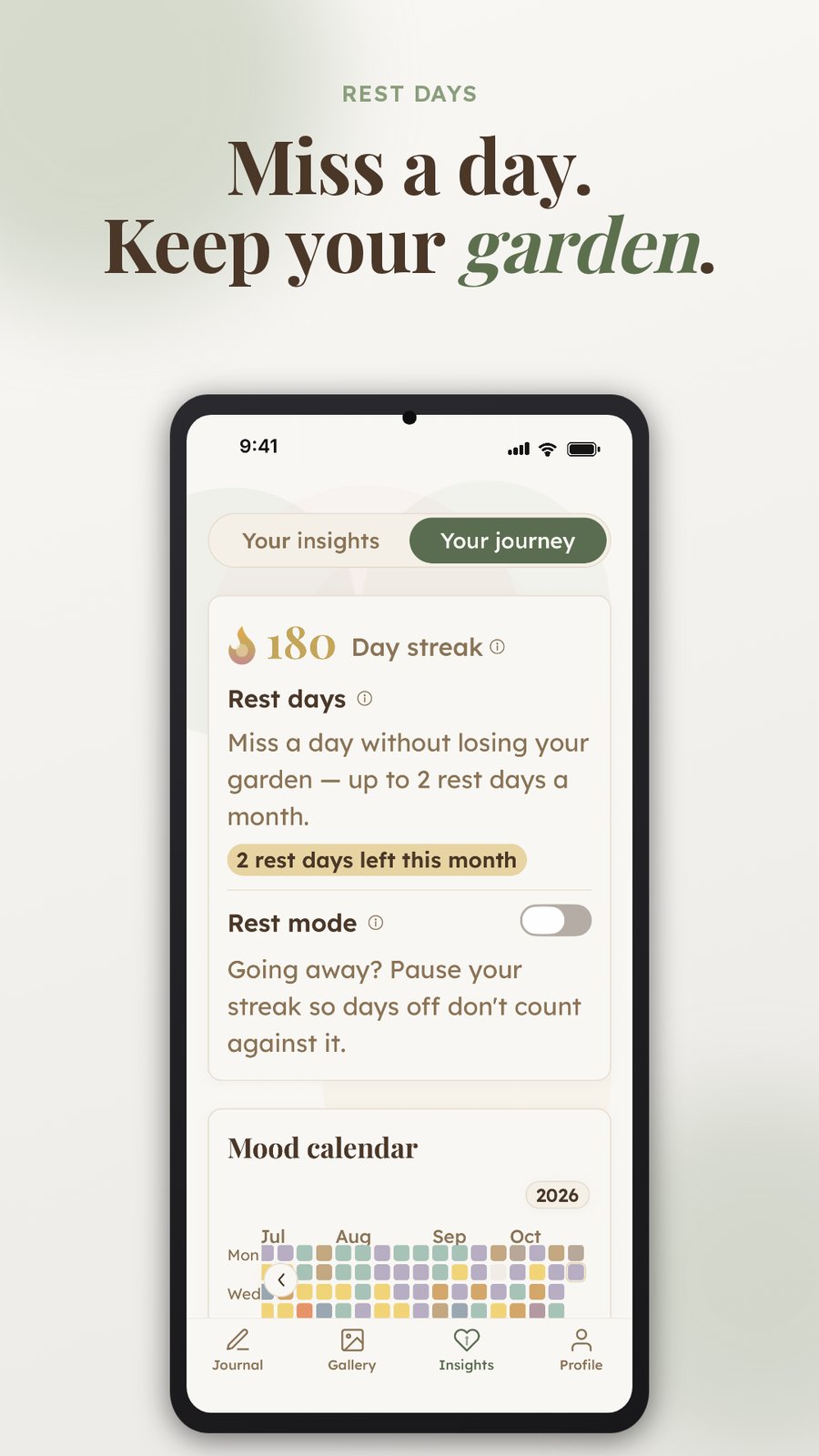
Writing, saving, reading back and exporting your journal are free forever, on every plan. Paintings come with Bloom Pro: up to 90 paintings and 4 living paintings a month for €9 a month or €49 a year (as of November 2026, in your store’s local currency). A 7-day trial comes first, with up to 3 paintings a day. Your journal lives on your phone by default. To paint an entry, its text is sent to Google Gemini; what happens to your words is written down in the Privacy Policy. Bloom is on Google Play for Android; the iPhone version is on its way to the App Store.
Miss a day without losing your garden.

On Android now. The iPhone version is on its way to the App Store.
Questions
What is the best gratitude journal app for someone who keeps quitting?
Look for two things: prompts for the days you have nothing to say, and a streak that does not reset to zero over one missed day. Gratitude and Day One both offer free prompts and reminders. Bloom covers two missed days a month automatically and has a Rest mode for holidays. Check each app’s missed-day rule before you commit.
Which journaling apps are good for a gratitude practice?
Gratitude is built for it, with prompts, reminders, affirmations and vision boards. Day One is a general journal with a daily prompt and templates. Bloom can turn an entry into a painting to keep (paintings come with Pro). Paper is still a good choice if you prefer no screen at night.
Can I take a break from gratitude journaling without losing my streak?
On paper there is no streak to lose. In apps it depends on the app. In Bloom, two rest days a month cover missed days without you doing anything, and Rest mode pauses the streak for a holiday or a hard week.
How do I start a gratitude journal if I don’t know what to write?
Write three specific things: something that happened, something you noticed, and something that made the day easier. If nothing comes, answer one prompt, such as “Who made today a little easier?”. A single honest line still counts.